WHICH IS THE BEST MORA KNIFE?
Mora, or rather, Morakniv (pronounced: ˈmuːra.ˈkniːf), isn't just any cheap hardware store knife that you can buy for under ten euros at the nearest DIY paradise. Well, actually, it is, because that's what Mora is ultimately known for: affordable, good tools. But the history and tradition behind Mora is much deeper than one might initially suspect. Let's start with the name: Mora is not only the name of the company behind the knife, but Mora is a place in the heart of Sweden, the Solingen of the North, if you will, where various knife manufacturers, predominantly small manufactories and family businesses, have been located for over 400 years.
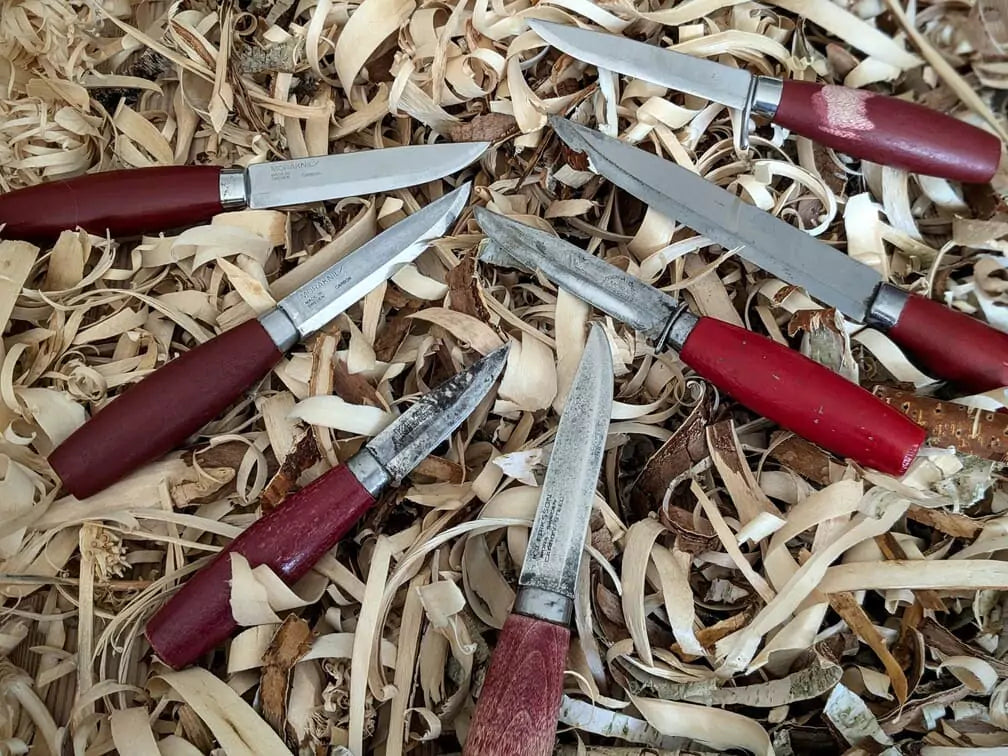
With the beginning of the 20th century, the businesses grew, and manufacturers like AB Carl Anderssons Knivfabrik, AB Moraknivar, Bröderna Jönssons, Frosts or KJ Erikssons made a name for themselves internationally. From the middle of the last century, the manufacturers, all producing very similar knife types (the classic Mora with its round birchwood handle and red color is iconic here), gradually began to merge, until all these business mergers resulted in the Morakniv we know today in 2005.
MORA IN THE 21ST CENTURY
Mora is today one of the best-known and largest knife manufacturers worldwide. As a knife and outdoor enthusiast, you can't avoid this name, and for good reason: Moras are famous for being robust, capable, and versatile, yet still affordable for every budget. The good people at Morakniv listen to customer feedback and are constantly developing new models and model variants.
Anyone looking to buy a Mora today can easily be overwhelmed by the large product range and rightly wonder which is the best Mora knife. This article aims to introduce you to the best-known and most popular Moras for the outdoor and bushcraft sector and to show fundamental differences between the individual models. All knives presented here are user models and have served me personally for many years.
– The All-Rounder –
MORA COMPANION
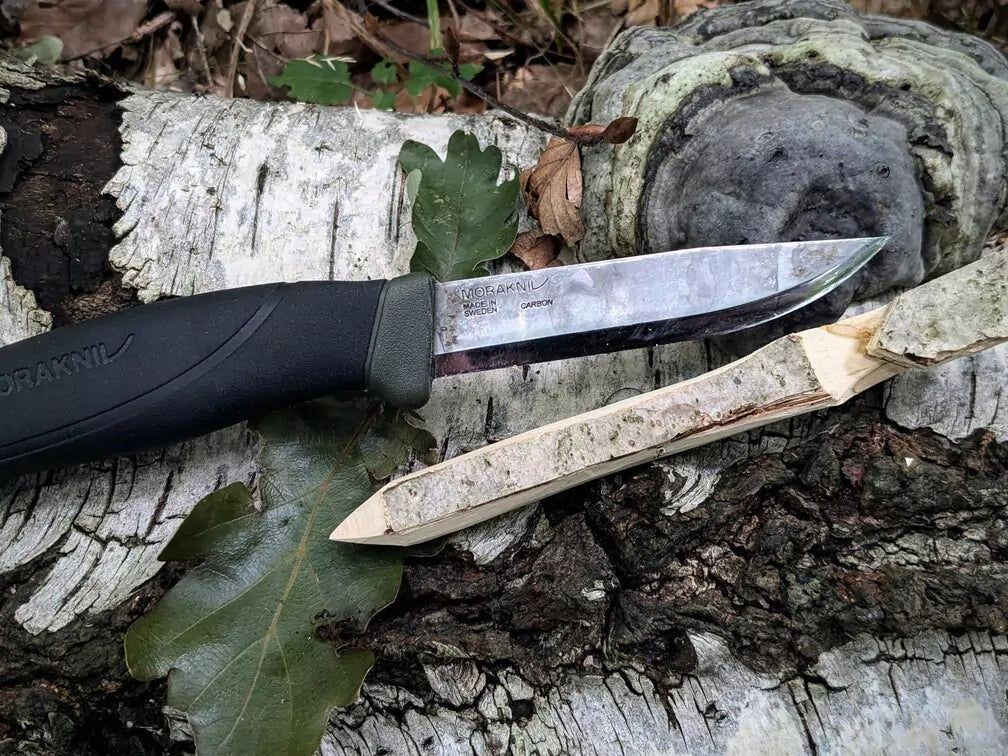
The Mora Companion is the perfect all-rounder and a true classic in the Mora line-up. As the successor to the Mora Clipper (which outdoor enthusiasts among you probably know as the Bauhaus and Bahco knife (especially in the combo pack with the Bahco Laplander saw)), the Companion is now considered a modern classic, a bestseller, and probably THE most popular Mora knife of all.
The Companion is available in two variants: Carbon (until approx. 2022 declared as C100) and Stainless (until approx. 2022 declared as Sandvik 12C27), with the carbon variant having a slightly thinner blade thickness of 2 mm than the stainless variant (2.5 mm). The spine of the blade is rounded, so it cannot be used to strike a firesteel – but this offers more comfort for thumb placement. And for those who are bothered by it: with a file, the spine of the blade can be sharpened in a few minutes. The Companion goes through wood like butter and is ideal for carving, but it is also an excellent choice for various bushcraft tasks such as preparing firewood, harvesting birch bark, slicing cucumbers, or skewering mosquitoes. Due to its virtually non-existent weight, there is no excuse not to have this knife with you outdoors.
- Carving
- Hiking
- Bushcraft
- Crafts
- Everyday tasks
- Light and tougher tasks
- Blade length: 104 mm
- Blade thickness: 2.5 mm Stainless / 2 mm Carbon
- Overall knife length: 219 mm
- Overall knife length with sheath: 240 mm
- Weight: 117.0 g Stainless / 110.0 g Carbon
- Steel: Carbon/Stainless
- Fire steel compatible: No
- Handle material: TPE rubber
- Handedness: For left and right-handers
- Blade protection: Polymer sheath
- Sheath orientation: Right
– The Robust One –
MORA COMPANION HD
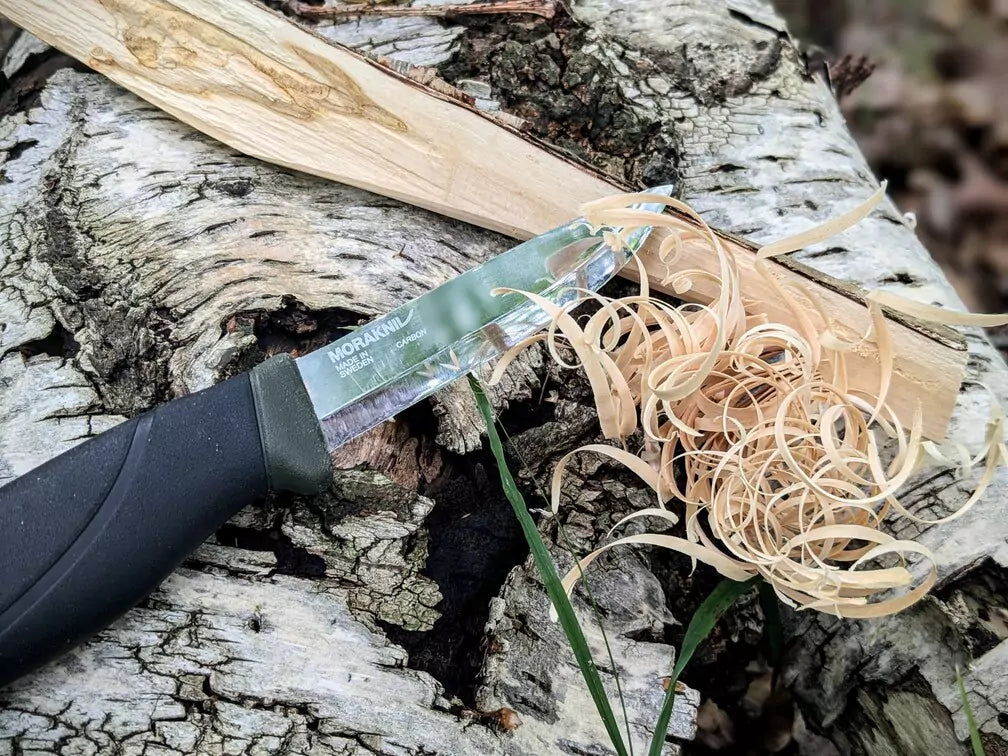
The Mora Companion HD is the big brother of the standard Companion and differs mainly in two characteristics: the blade thickness (3.2 mm vs. 2.5 or 2 mm for the Companion Stainless and Carbon) and the thickness and length of the handle. The blade length is identical to that of the standard Companion. This knife is excellent for larger hands and fits – at least in my delicate paws – extremely well in the hand. You can work comfortably with it for hours without creating hot spots on your hands. Despite the fact that the Companion HD is not full-tang, it is still very robust and effortlessly withstands some tougher use. For the price and for the weight, the Companion HD is, in my opinion, more knife than you could wish for, and belongs in every knife drawer – not just for bushcrafters.
- Carving
- Hiking
- Bushcraft
- Crafts
- Everyday tasks
- Light and tougher work
- Blade length: 104 mm
- Blade thickness: 3.2 mm (both stainless and carbon)
- Overall knife length: 224 mm
- Overall knife length with sheath: 240 mm
- Weight: 135.0 g
- Steel: Carbon/Stainless
- Fire steel compatible: No
- Handle material: TPE rubber
- Handedness: For left- and right-handed users
- Blade protection: Polymer sheath
- Sheath orientation: Right
– The Bushcrafter –
MORA BUSHCRAFT BLACK
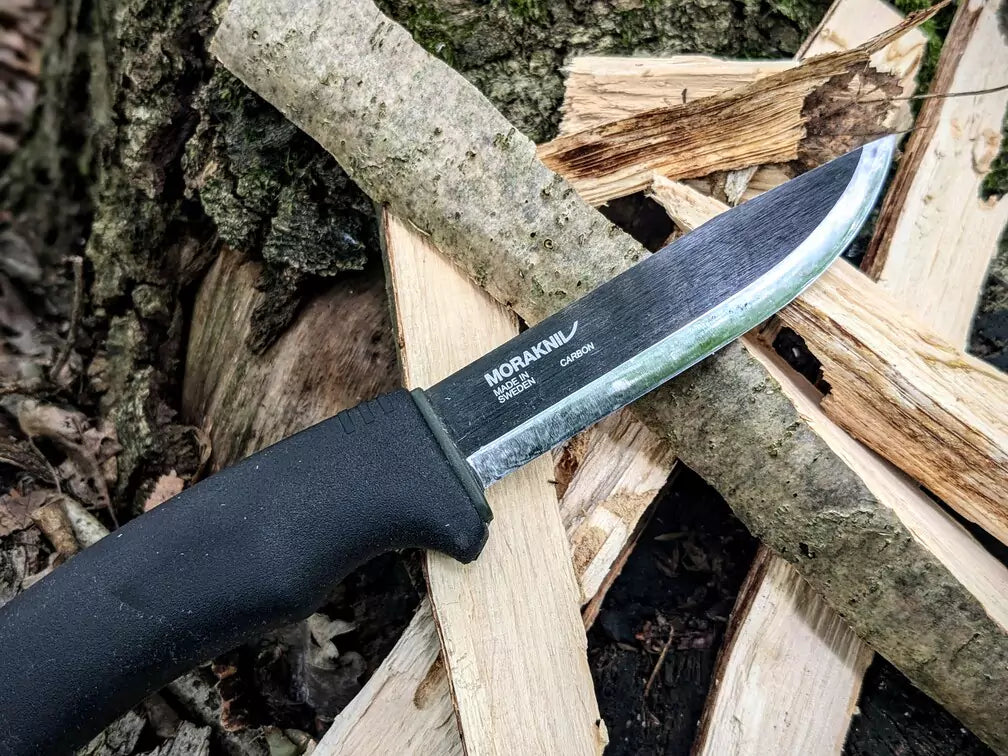
The Mora Bushcraft Black was long considered Mora's prestige bushcraft knife before the Garberg came along. The Bushcraft is available in numerous versions (some, like the Bushcraft Triflex, are now discontinued), but the Black version with coated carbon steel and a 90° spine is the most popular. I personally prefer the handle of the Kansbol or the Garberg, as I'm not particularly fond of predefined finger grooves, but many swear by the comfort of the handle on the Mora Bushcraft. Thanks to the fully rubberized grip, it offers absolutely divine hold.
The tang is not full (so it's not full-tang, if that's a dealbreaker) – but it's still robust, and you'd have to go to great lengths, à la Joe X, to break this club. Due to the special injection of the tang into the plastic, Moras are generally very robust and resistant, and with the Bushcraft Black, this has a positive impact on the weight: For a bushcrafter, it's extremely light and is virtually unnoticeable in a backpack or on a belt.
- Hiking
- Bushcraft
- Outdoor
- Light and tougher work
- Blade length: 109 mm
- Blade thickness: 3.2 mm
- Knife length: 232 mm
- Overall length: 258 mm
- Weight (net): 174.6 g
- Steel: Carbon (coated)
- Fire starter compatible: Yes
- Handedness: For left and right-handers
- Blade protection: Polymer sheath
- Sheath orientation: Right
– The Versatile One –
MORA KANSBOL
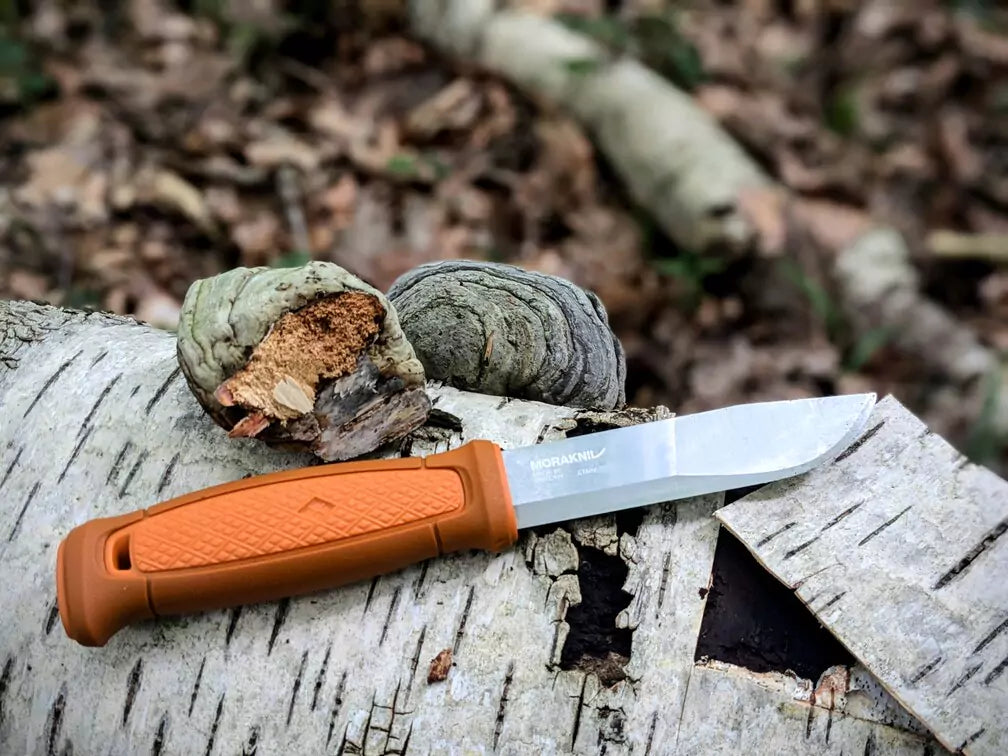
2016 was a good year for the outdoor community. It was the year Mora released three of its most successful knives: The Mora Kansbol, the Garberg, and the Eldris (more on the latter two below). With its barrel handle, the Kansbol clearly harks back to the classic, red birch handles of the original Moras and is excellently suited for any grip technique. In a hammer grip, in a reverse grip, with a chest lever – this handle is always comfortable, and thanks to the rubber coating on the upper and lower edges, the knife lies non-slip in the hand.
However, probably the most obvious special feature of this knife is the so-called compound grind, which we already know from the Mora 2000, which debuted in the 1990s. While the blade near the handle is a classic Scandi and provides excellent carving properties there, the blade tip tapers towards the front, and the Scandi grind transitions into a kind of flat grind with a high primary bevel. Since this question comes up frequently: The sharpening angle remains constant! Resharpening this model is therefore not witchcraft. Due to the thin blade thickness of 2.5 mm (tapering towards the front), this knife is extremely good at cutting, and thanks to the front grind, it is also well suited for food preparation. In contrast to the Mora 2000 or Bushcraft Forester, the Kansbol has a 90° blade spine and sparks like crazy. The Kansbol is one of my all-time favorites and a true generalist for hiking, bushcrafting, and being outdoors.
- Carving
- Hiking
- Bushcraft
- Camp Cooking
- Hunting (?)
- Blade length: 109 mm
- Blade thickness: 2.5 mm
- Knife length: 226 mm
- Overall length: 250 mm
- Weight: 134.0 g
- Steel type: Recycled stainless steel from Sweden
- Fire steel compatible: Yes
- Handle material: TPE rubber
- Handedness: For left and right-handers
- Blade protection: Polymer sheath
- Sheath orientation: Left, Right
– The Survivalist –
MORA GARBERG
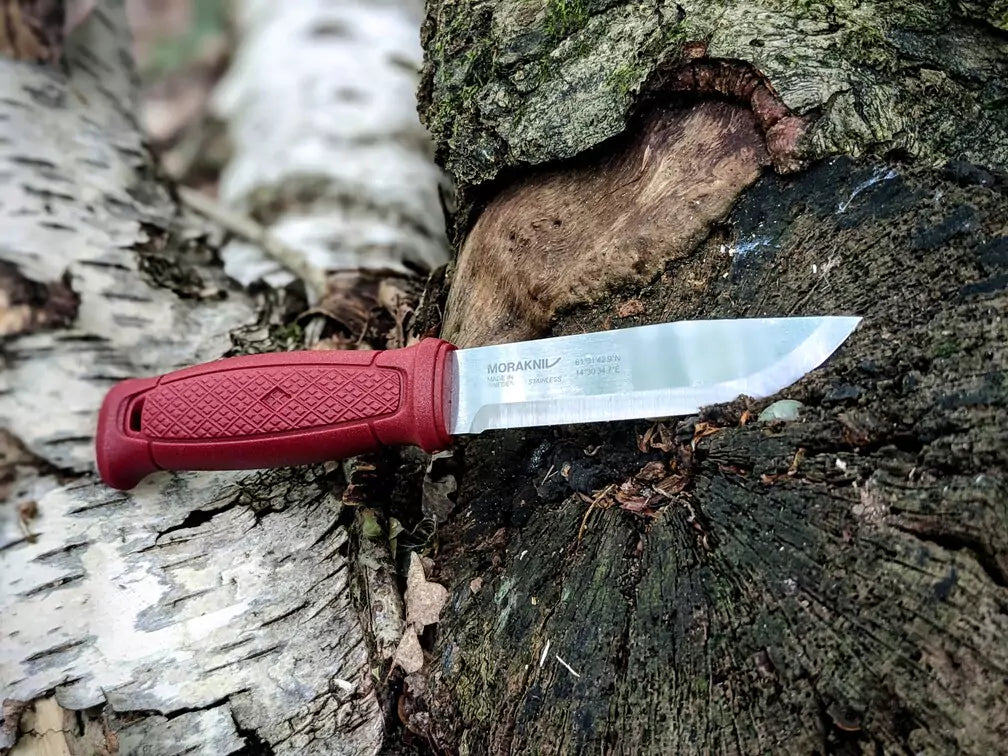
The Mora Garberg, released in 2016, is the logical answer to the scene's outcry for full-tang and survivalability. Until the Ashwood series, the Garberg was Mora's only full-tang knife, and it hit the outdoor scene like a comet. To this day, it is considered one of the most popular knives for bushcraft and outdoor use. The handle is very similar to that of the Kansbol, except that the Garberg's handle is made entirely of hard plastic without rubberization. However, this does not detract from comfort or performance. This knife feels massive in the hand and exudes a confidence as if it could fight its way through any hard wood, no matter how stubborn.
The Garberg is available in Carbon (with black coating) and Stainless, with a polymer or leather sheath, with and without a multi-mount system. The price point here is higher than the pleasant Companion, but the extra cost is worth it in terms of stability and build quality.
- Bushcraft
- Survival
- Carving
- Hard Work
- Blade length: 109 mm
- Blade thickness: 3.2 mm
- Knife length: 229 mm
- Overall length: 242 mm
- Weight: 207.0 g
- Steel type: Recycled stainless steel from Sweden
- Fire steel compatible: Yes
- Handle material: Polyamide
- Handedness: For left and right-handers
- Blade protection: Polymer sheath
- Sheath orientation: Left, Right
– The Arsonist –
MORA EDLRIS
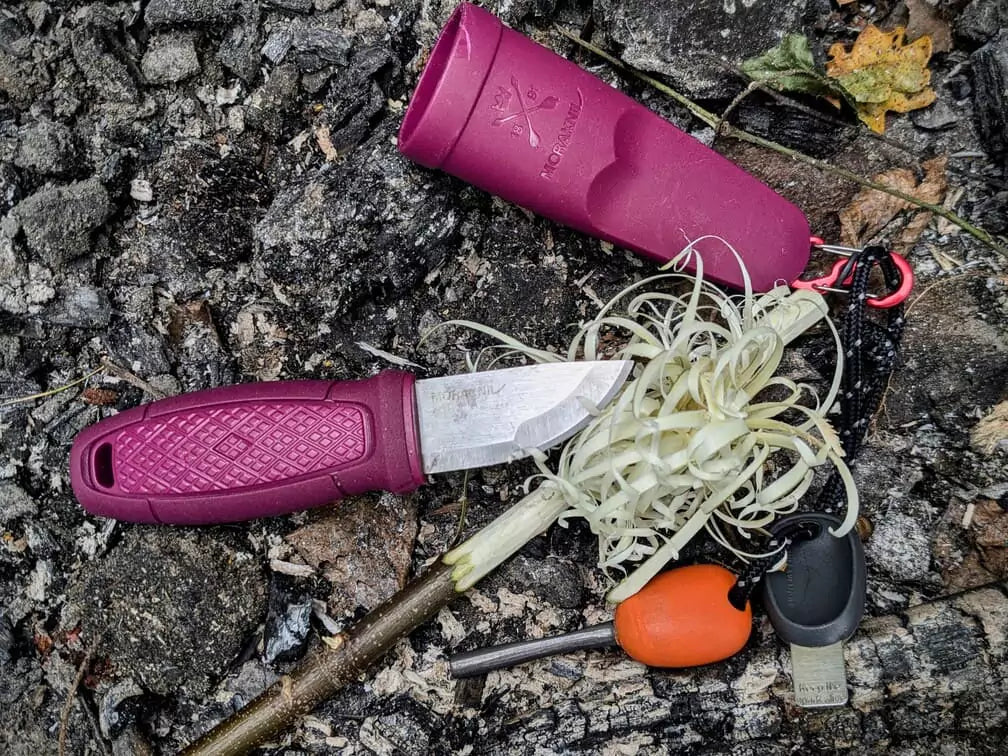
The Mora Eldris is a handy little companion and Morakniv's answer to the community's wish for a pocket knife. The handle is designed on the same principle as the Kansbol and Garberg, and despite its significantly more compact dimensions, the Eldris (at least for glove size 10) fits just as comfortably and excellently in the hand as its larger siblings. The Eldris is available in two versions: a standard version with a compound grind (cf. Kansbol) and a Light Duty version with a full Scandi grind and a rounded blade spine. In the standard version, the Eldris is available both individually and as a Neck-Knife Fire-Kit, the latter including a strap lock, a fire steel, and a neck strap. This allows the Eldris to be worn securely upside down as a neck knife.
The fire steel and the name Fire-Kit already give a direct hint as to the preferred application of the Mora Eldris: making fire. With its 90° blade spine, the Eldris sparks just as gloriously as the Kansbol and the Garberg – but its short blade allows for much more control, while its comfortable grip makes it much more manageable than commercially available fire steel scrapers (even if the Light My Fire one is already very good). Like every other Mora, the Eldris is a little cutting devil, although its short blade is naturally somewhat less suitable for longer cutting movements than, for example, the Companion. You won't halve a watermelon with the Eldris. However, for carving curls, scraping kindling, and making fire, the Eldris is the king of campfires. The advantages of the Eldris in this regard are difficult to convey – you simply have to try it out.
Note: The Light Duty version comes with a rounded blade spine and is therefore not inherently suitable for striking fire steels!
You can buy the Mora Eldris here in our shop.
By the way: You can also find Light My Fire fire steels in our shop.
- Bushcraft
- Fire starting
- Carving
- Light work
- Blade length: 59 mm
- Blade thickness: 2 mm
- Knife length: 145 mm
- Total length: 153 mm
- Weight: 80 g
- Steel type: Recycled stainless steel from Sweden
- Fire steel compatible: Yes
- Handle material: TPE rubber
- Handedness: For left and right-handers
- Blade protection: Polymer sheath
- Sheath orientation: Left, Right
If you want to learn more about the history of Morakniv, I strongly recommend the historical catalogs on the Mora website (see sources below) as well as the Mora blog by Mora enthusiast and expert João. If you're interested in outdoor knives in general, we've put together an outdoor knife guide here.
Discover a wide selection of Mora knives in our shop.
Sources:
https://morakniv.se/en/this-is-morakniv/our-history/, accessed: 13.07.2024
https://morakniv.se/en/this-is-morakniv/historical-catalogs/, accessed: 13.07.2024
*All information according to product details on https://morakniv.se/en/, last accessed on 13.07.2024.
More blog posts
What makes a good outdoor knife? A guide.
Are you looking for an outdoor knife? We'll show you what to consider when buying one and what different types of knives there are.
Read more